

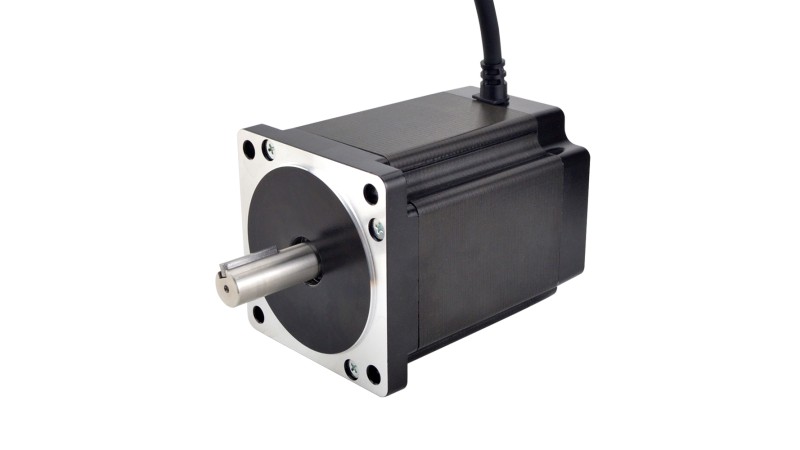
Selecting between a two-phase and a five-phase stepper motor requires a clear understanding of your application's demands versus the motor's inherent capabilities. While a higher phase count offers specific advantages, it also comes at a higher cost. "More" is not automatically "better." This analysis, based on comparative testing, reveals why a modern two-phase system often presents a superior balance of accuracy, thermal performance, and value.
A Surprising Result in Positional Accuracy
To compare these mechanically distinct motors, we tested both at a microstep resolution equivalent to 0.018 degrees. This required driving a standard 0.9-degree two-phase motor at 50 microsteps/full step and a 0.72-degree five-phase motor at 40 microsteps/full step.
The result was revealing: the two-phase motor demonstrated four to five times lower step error than the five-phase motor.
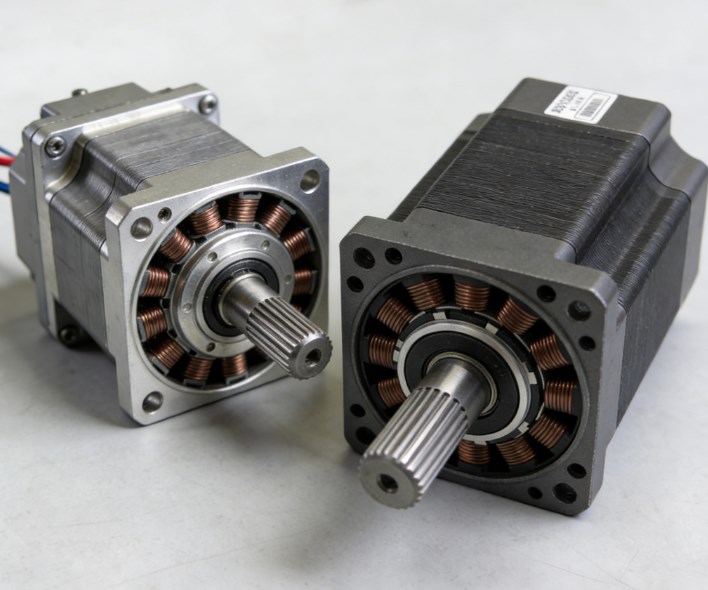
This outcome stems from a fundamental design difference: positional accuracy in a stepper motor is largely determined by the number of stator and rotor teeth. While typical five-phase motors utilize 10 stator poles, the tested two-phase motor employed a 12-pole stator design. More stator poles mean more teeth interacting within the motor, directly translating to the higher positional accuracy observed in the test data.
Re-evaluating the Torque Ripple Argument
A primary historical driver for choosing five-phase motors has been their reduced torque ripple in full-step operation. However, this comparison is becoming less relevant for modern applications.
- The Prevalence of Microstepping: Most high-performance applications today use microstepping drivers, not full-step operation. As our test shows, in microstepping mode, the two-phase motor's drastically lower error becomes a critical advantage for precision positioning.
- Driver Technology Advancements: Recent innovations in two-phase stepper driver technology have significantly minimized torque ripple. This allows two-phase systems to meet the smoothness requirements of applications that once necessitated a five-phase motor.
Inherent Advantages of the Two-Phase System
Beyond accuracy, the two-phase architecture offers two further benefits:
- Lower Heat Dissipation: A two-phase motor driver utilizes eight power transistors, compared to the ten required for a five-phase driver. With fewer components switching, the two-phase driver inherently generates less heat, simplifying thermal management and heat-sinking requirements—a crucial factor in compact or sealed enclosures.
- Cost-Effectiveness: The simpler construction of the two-phase motor and its associated driver translates directly into a lower total system cost.
Conclusion: Making the Informed Choice
The decision should be guided by application priorities:
- Choose a five-phase stepper motor if your application is extremely sensitive to torque ripple and will operate primarily in full-step mode, where its smoothness advantage is most pronounced.
- Choose a modern two-phase stepper motor (paired with an advanced microstepping driver) for the vast majority of applications prioritizing high positional accuracy, lower heat generation, and overall cost-efficiency. With today's technology, the two-phase system reliably "steps up" to meet demanding requirements.
In short, unless torque ripple in full-step mode is the absolute paramount concern, a well-engineered two-phase solution frequently provides the optimal performance and economic solution.